
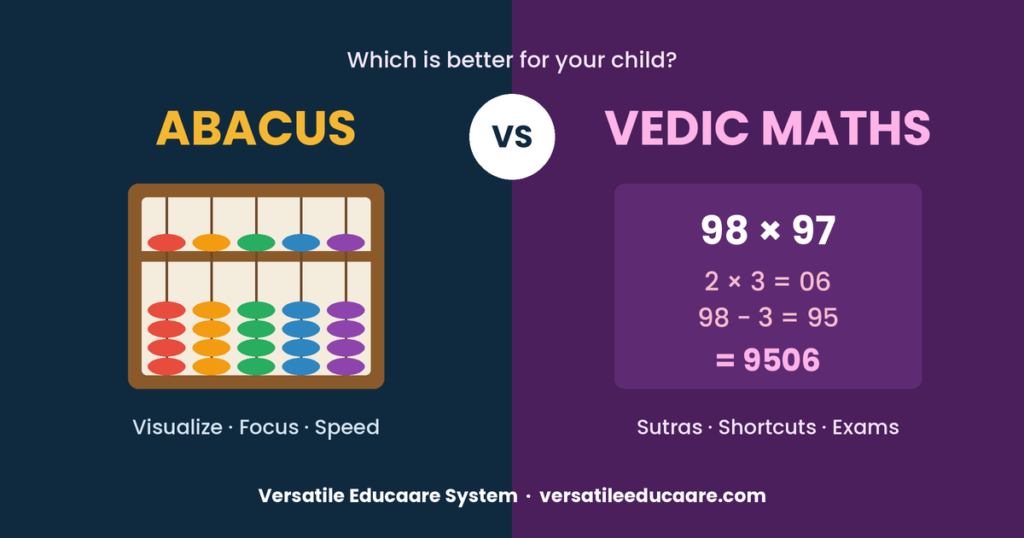
You want your child to be fast and confident in maths. You start looking for classes and find two popular options: abacus and Vedic Maths. Both promise faster calculation. Both are loved by parents. So which one should you choose?
The honest answer is that they are different tools for different stages. In this blog, we explain how each method works, compare them side by side, and help you decide which one suits your child’s age and goals.
What Is Abacus?
An abacus is a counting frame with beads on rods. Children first calculate by moving the beads with their fingers. Over time, they learn to picture the abacus in their mind and solve sums mentally, a skill called abacus mental arithmetic.
Because it uses visualization, abacus training also exercises memory and concentration. A study in The Journal of Neuroscience found that abacus-based mental calculation training improved visuospatial working memory in children. To learn more, read our blog on abacus course benefits, levels and the right age.
What Is Vedic Maths?
Vedic Maths is a set of mental calculation techniques compiled by Swami Bharati Krishna Tirtha in the 20th century. It is built around 16 short formulas, called sutras, that give quick shortcuts for multiplication, division, squares, square roots and more.
Instead of a physical tool, Vedic Maths uses number patterns and rules. Children learn to break a big calculation into small, easy steps they can often do in one line or in their head.
Abacus vs Vedic Maths: Side-by-Side Comparison
| Point | Abacus | Vedic Maths |
| How it works | Visualizing beads on a mental abacus | Shortcut formulas (sutras) and number patterns |
| Tool used | Physical abacus at first, then imagination | Pen, paper or mental steps |
| Best starting age | About 5 to 14 years | Usually 10 years and above |
| Prior knowledge needed | Basic numbers only | Comfort with tables and basic operations |
| Main strength | Speed in addition, subtraction and basic operations | Shortcuts for multiplication, squares, roots and complex sums |
| Brain skills built | Concentration, visualization, memory, listening | Logical thinking, number sense, flexibility |
| Most useful for | Building a strong maths foundation early | School exams and competitive exams |
Benefits of Abacus
- Builds a strong maths foundation from a young age
- Improves concentration, memory and listening skills
- Develops fast, accurate mental calculation
- Turns maths into a hands-on, fun activity for young children
Benefits of Vedic Maths
- Gives quick shortcuts for multiplication, division, squares and roots
- Reduces steps and saves time in exams
- Builds logical thinking and a deeper understanding of numbers
- Very useful for older students preparing for competitive exams
Which One Should Your Child Learn?
The right choice depends mainly on your child’s age and what you want them to achieve.
- Age 5 to 9: Start with abacus. It needs only basic number knowledge and builds concentration and visualization when the brain is developing fast.
- Age 10 and above: Vedic Maths is a great fit, especially if your child already knows tables and wants faster methods for school and competitive exams.
- Best of both: Many children learn abacus first and move to Vedic Maths later. Abacus builds the mental strength, and Vedic Maths adds powerful shortcuts on top.
Abacus and Vedic Maths at Versatile Educaare System
Versatile Educaare System (VES) offers both programs under our Brain and Skill Development Programs. Our Brain Booster (Abacus) program takes children from the physical abacus to full mental calculation, and our Vedic Maths program adds smart shortcuts for older students.
Our teachers complete the VES certified teacher training program for Abacus and Vedic Maths. Schools can also add both skills to the daily timetable through our school programs.
Frequently Asked Questions
Is abacus better than Vedic Maths?
Neither is better for everyone. Abacus suits younger children building a foundation, while Vedic Maths suits older students who want shortcuts for advanced calculations.
Can my child learn abacus and Vedic Maths together?
It is usually better to learn them one after the other, starting with abacus. This avoids confusion between the two methods.
Is Vedic Maths useful for competitive exams?
Yes. Its shortcuts help students save time in exams that test fast calculation.
What is the right age to start Vedic Maths?
Most children start Vedic Maths around 10 years or older, once they are comfortable with tables and basic operations.
Choose the Right Path for Your Child
Abacus and Vedic Maths are not rivals. They are two steps on the same journey to faster, more confident maths. Start with abacus for a strong foundation, and add Vedic Maths when your child is ready for advanced shortcuts.
Not sure which program fits your child? Explore our Abacus and Vedic Maths programs or visit Versatile Educaare System to book a session.